


Anyone who's even a little interested in skincare has, sooner or later, stumbled upon the term "Double Cleansing." What sounds like an elaborate extra step in an already lengthy evening routine has been a long-established practice in Korea for decades – and for good reason.

An oil cleanser isn't just oil; it must be able to emulsify with water to avoid leaving residue in the pores.
The Korean Roots
Double cleansing is a core component of the Korean skincare routine, which is globally recognized as one of the most advanced. In Korea, skincare holds deep cultural significance – flawless, well-cared-for skin has been considered a sign of health and self-respect for centuries. The Korean beauty industry has professionalized and scientifically substantiated this tradition over generations.
The basic idea behind double cleansing is simple and logical: different types of dirt require different types of cleansing. If you overlook this and only wipe your face with a single product in the evening, you might be cleaning superficially – but not deeply enough.
What's Behind It: Oil Dissolves Oil
The principle of double cleansing is based on a chemical axiom: "Like dissolves like." The skin produces sebum daily, an oily protective film. At the same time, we apply sunscreen, foundation, concealer, and other products that are also oil or wax-based and are difficult to remove with water.
This is precisely the problem with conventional cleansers: they are designed for water-soluble dirt – sweat, dust, pollution. They often struggle to tackle sebum that has settled in the pores or waterproof mascara. The result: the skin may feel fresh after washing, but in reality, it isn't truly clean. Excess sebum and product residues remain, settling into the pores and can, in the long term, promote blemishes, enlarged pores, and an uneven complexion.
An oil-based cleanser solves this problem: it binds oil-soluble impurities, including excess sebum in the pores, and makes them rinseable. Subsequently, a water-based cleanser ensures that even the last remnants of sweat and dirt are removed – leaving the face truly clear.

Every double cleanse is a little ritual of self-care and a blood-circulating massage for firm skin.
Step by Step: How to Do It Right
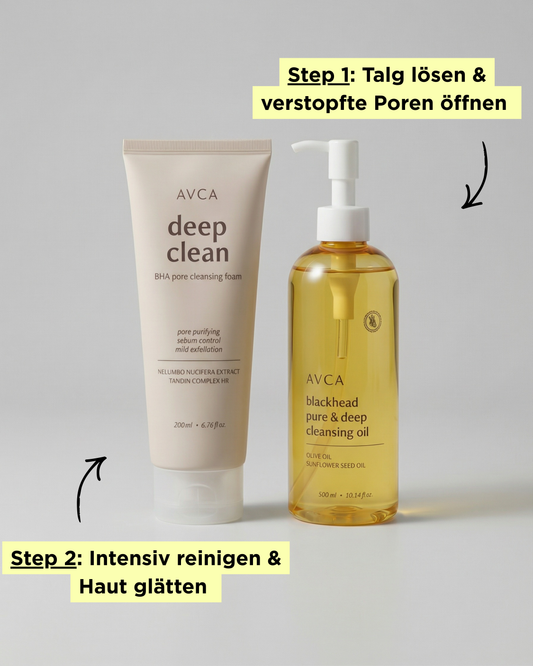
Step 1 – Oil-based cleansing: First, apply a cleansing oil or cleansing balm to dry skin and gently massage it in – for at least 60 seconds. During this time, the oil dissolves make-up, sunscreen, and sebum. When you add a little water, the product emulsifies: it turns milky, combines with the dissolved impurities, and can be easily rinsed off. Products that don't emulsify, such as pure coconut oil or almond oil, leave an oily film and are harder to rinse off – not a good choice for combination or oily skin.
Step 2 – Water-based cleansing: This is followed by a mild water-based cleanser, such as a gel cleanser, cleansing milk, or foam cleanser. It removes water-soluble residues and ensures no oily film remains on the skin. After this step, your skin should feel clean but not dry – a sign that the cleanser is gentle and skin-friendly.
Who is Double Cleansing suitable for?
The short answer: for most people who wear makeup or sunscreen in the evening. Anyone who applies SPF daily – and everyone should – benefits significantly from the first cleansing step, as sunscreen filters often stubbornly cling to the skin.
Double cleansing is also particularly beneficial for skin prone to blemishes and blackheads. Since sebum is one of the main causes of clogged pores, consistent oil cleansing can contribute to clearer skin in the long term. Ironically, people with oily skin often shy away from the first step with an oil cleanser – yet it is especially valuable for them.
For very dry or sensitive skin, some caution is advised: double cleansing twice a day can dry out the skin in the long run. In this case, double cleansing once in the evening is completely sufficient – in the morning, lukewarm water or a particularly mild, single cleanser is often enough.

Not every product is suitable – it's about the combination.
A common misconception about double cleansing is that any two cleansing products will suffice. However, the selection and interaction of the products are crucial – because if combined incorrectly, the method can even stress the skin, clog pores, or leave an unpleasant film.
For the first step, only oil-based products that emulsify on contact with water – meaning they turn milky and rinse off cleanly – are suitable. Pure vegetable oils like coconut oil might sound temptingly simple, but they have a crucial disadvantage: they don't emulsify and are difficult to rinse off completely. The residues settle into the pores and can, in the long term, promote blackheads and blemishes – the opposite of the desired effect. A high-quality cleansing oil or a cleansing balm specifically formulated for the face is clearly the better choice here.
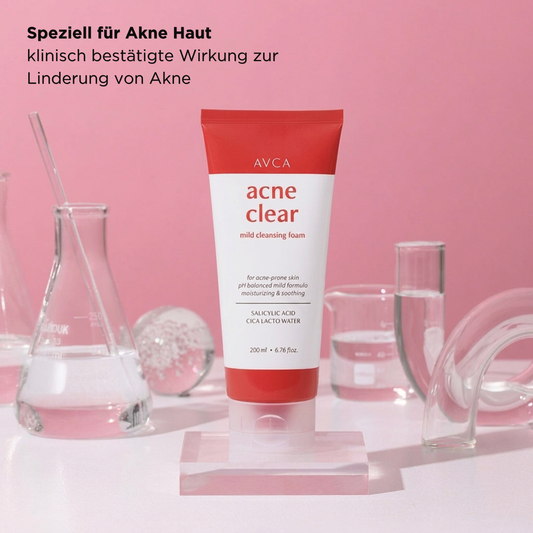
The second step ensures that no oil residues remain on the skin – and that's precisely why the water-based cleanser shouldn't just be any product. An ideal choice is a foaming, gentle cleanser that is thorough enough to remove the last traces of oil and product residues, yet does not attack the skin's natural protective barrier. An overly aggressive foam cleanser not only removes dirt but also important skin lipids – the skin reacts with dryness or, paradoxically, with even more sebum production.
In short: the products must be coordinated. An emulsifying oil in the first step, followed by a gentle, slightly oil-dissolving foam cleanser in the second – only then does double cleansing unfold its full effect without stressing the skin.

The result everyone wants: clear, fine-pored, even skin with a healthy, vital glow.
Why is Double Cleansing so popular?
Double Cleansing has gained worldwide popularity because it works – and because many people only realize how incomplete their previous cleansing routine was after switching. Once you've experienced how your skin feels after a thorough double cleanse – soft, clean, without the unpleasant tightness from aggressive cleansers – you won't want to go back.
Additionally, Double Cleansing enhances the effectiveness of the rest of your skincare. Serums, moisturizers, and active ingredients can be absorbed much better by the skin when it is truly thoroughly cleansed. Skincare simply works more efficiently on clean skin – making Double Cleansing an investment that benefits your entire routine.
Conclusion: Two Steps, Big Difference
Double cleansing is not a trend that will disappear as quickly as it appeared. It's a well-founded cleansing method based on a simple chemical principle and has been proven in Korea for generations. Those who consistently double cleanse in the evening lay the best foundation for healthy, well-cared-for skin – and will notice after just a few weeks that the small extra effort is worth it.






4 comments
tla6bw
cf93ou
Sehr spannend, werde ich ausprobieren!
Richtig geil, ich habe auch Double Cleansing probiert und mich immer gefragt wieso meine Haut sich komisch ölig anfühlt, aber es macht total Sinn, dass man nicht einfach Öl verwendet. Ich liebe eh euere Snail Cream von Avca. Sofort euer Set bestellt 🤩🤩🤩