Why gentle care and the right routine can change everything for sensitive skin
I remember clearly the moment I first stood in front of the mirror and noticed the tiny, red pustules around my mouth. I was in my early 20s and thought I had left all my skin problems behind.
At first, I thought it was a common rash, perhaps a reaction to a new product. But days turned into weeks, and the redness didn't disappear. On the contrary: my skin felt tight, itchy, and reacted more and more sensitively to skincare products. My dermatologist's diagnosis was clear: perioral dermatitis.
What followed was a long journey through misinformation, useless and painful internet advice, unhelpful dermatologists, abstaining from skincare products, and finally a fresh start with a completely new approach – Korean cosmetics.
In this post, I want to share my personal story and show how I managed to bring my skin back into balance – without aggressive medication, but with patience, knowledge, and the right products.

Sufferers of perioral dermatitis know the rough, tight areas with pustules around the mouth
What is perioral dermatitis?
Perioral dermatitis (POD for short), also known as "stewardess' disease," is a chronic inflammatory skin condition typically characterized by reddish, inflammatory papules and pustules around the mouth. In severe cases, the condition can also spread to the nose and eye area. A characteristic feature is that a narrow strip of skin directly at the lips often remains unaffected – a diagnostic clue that many dermatologists immediately notice.
The exact cause of POD is not yet fully understood, but a multifactorial interplay is considered probable. The most common triggers include:
-
Over-care of the skin: The so-called "overuse" of cosmetic products, especially creams, can disrupt the natural skin barrier. Many sufferers report that the disease appeared shortly after the introduction of new, especially rich, products. Natural cosmetics often contain fragrances, heavy humectants, and essential oils that can be very irritating to the skin. As the skin becomes drier, people increasingly resort to heavy creams, which progressively worsens the skin's condition.
-
Topical corticosteroids: Repeated or long-term use of corticosteroid-containing creams – often prescribed even for skin irritations – can trigger or worsen POD.
-
Fluoride-containing toothpaste: In some cases, a connection between POD flare-ups and toothpastes with certain fluoride compounds has been observed.
-
Hormonal fluctuations, stress, and climatic influences: Like many skin conditions, POD is sensitive to internal and external influences.
-
Rarely heard: But genetics also plays a role: It would otherwise be a strange coincidence that my mother and sister also suffer from perioral dermatitis. Inherited very sensitive skin is more susceptible to over-irritation and over-care.
The disease primarily affects women between 20 and 40 years of age. This is not least because this target group tends to use more skincare products – sometimes to the point of "over-care," where the skin is literally overwhelmed.
The scientific background: What happens in the skin with POD
At the cellular level, POD shows a disturbed epidermal barrier. This barrier is normally responsible for protection against environmental factors and maintaining moisture. With a damaged barrier, there is increased transepidermal water loss (TEWL), the skin dries out, becomes irritable, and more susceptible to micro-inflammations.
In addition, there is an imbalance of the skin microbiome: The natural colonization of the skin with bacteria such as Cutibacterium acnes or Staphylococcus epidermidis can be disrupted by improper care, which promotes inflammatory reactions. Studies also suggest a possible involvement of yeasts of the genus Malassezia, which can more easily take hold on disturbed skin.
The treatment of POD traditionally involves so-called zero therapy – i.e., abstaining from all skincare products – which is a major challenge for many sufferers. Depending on the severity, antibiotic creams or oral medications may also be used. But there is another way: with a well-thought-out skincare concept that strengthens the skin barrier and does not overwhelm it, POD can be significantly improved – as in my case with Korean cosmetics.

The Korean layering principle was my way out of the perioral dermatitis hell
My journey out of perioral hell was rocky
Before I could embark on this new path, however, I had to endure a veritable gauntlet of dermatological practices. Most dermatologists I consulted prescribed me cortisone creams or immunosuppressive ointments without much explanation – these sometimes helped in the short term, but everything got worse after stopping them.
No one talked about the skin barrier or the microbiome. I felt that my chronic skin condition was not being taken seriously, but rather dismissed. So I started researching myself: I read blogs, specialist articles, studies, and personal testimonials. In doing so, I came across the topic of the skin microbiome, the importance of an intact skin barrier, and the idea that one should not "fight" the skin with aggressive active ingredients, but rather support it with targeted care.
That's how I finally landed on Korean cosmetics – and the principle of skin layering. It felt like a liberation: finally an approach that respected my skin and didn't suppress it.
The first step was radical but necessary: a skincare diet. For two weeks, I abstained from all cosmetics, including cleansing. Just lukewarm water and a soft cloth, washed with sensitive detergent – nothing more. The goal was to allow the skin to calm down and break the cycle of irritation and overreaction.
During this phase, the skin undergoes a so-called rebound effect: it becomes drier, flakier, and tighter. But it's worth persevering. After about ten days, my skin began to calm down. I noticed less itching, and the redness subsided.
After that, I began to build a new routine step-by-step – inspired by the Korean 10-step method. But contrary to what many believe, this routine doesn't necessarily mean 10 products. It's more about the right order and sensible layering techniques.
Why Korean cosmetics in particular?
What immediately fascinated me about Korean skincare was its holistic, skin-barrier-friendly approach. Instead of temporarily masking symptoms, K-Beauty aims to make the skin healthy and resilient in the long term. Korean cosmetic products are known for their particularly skin-friendly philosophy – a crucial advantage for people with sensitive or inflammation-prone skin.
Korean skincare deliberately avoids ingredients that cause unnecessary irritation. Instead, it is dominated by:
-
mild formulations without aggressive alcohols, sulfates or fragrances that could disrupt the skin microbiome
-
multi-step, gentle care aimed at regenerating the skin barrier
-
functional ingredients such as Centella Asiatica, green teas, rice extracts, ceramides and fermented active ingredients that inhibit inflammation and bind moisture
-
innovative textures that feel light and breathable on the skin, without over-caring or occluding it
Many Korean products combine hydration with anti-inflammatory and microbiome-friendly properties – a rare combination in the Western cosmetics world. In addition, there are scientifically sound development processes and a deeply rooted culture of skincare, where skin is seen as a mirror of overall well-being.
The layering principle – applying several light products in a coordinated sequence – is also beneficial for sensitive skin. It allows precise control over the concentration of active ingredients and prevents irritation, which often occurs with thickly applied multi-functional products. A typical layering approach involves a multi-step skincare routine.
For someone with perioral dermatitis, this was revolutionary. Instead of "No Skincare" it was suddenly: "The right Skincare". Korean cosmetics showed me that skincare doesn't have to mean abstinence – but knowledge, selection, and mindfulness.
Which active ingredients should you use?
For perioral dermatitis, the choice of active ingredients is particularly sensitive, as the skin barrier is already damaged and inflammatory processes are exacerbated. The goal of care should therefore not be active "treatment" in the classical sense, but the stabilization of the epidermal barrier and the calming of neuroinflammatory stimuli.
Barrier-strengthening lipids such as ceramides, cholesterol, and fatty acids, which support the disturbed stratum corneum structure, have proven effective. Panthenol, beta-glucan, and allantoin promote regeneration and have an irritation-relieving effect without being occlusive. A central component of many Korean formulations is also Centella Asiatica, especially its active fractions like Madecassosides, which have anti-inflammatory effects and can support skin healing.
In addition, antioxidant plant extracts such as green tea or rice are used to reduce oxidative stress and alleviate redness. Characteristic of K-Beauty is also the use of fermented ingredients, which are often better tolerated due to their smaller molecular structure and support the skin microbiome.
The crucial factor is not the multitude of active ingredients, but a reduced, well-balanced formulation in low concentration – an approach that has proven particularly gentle on the skin, especially with perioral dermatitis.
Why not every product is suitable for you despite having the right active ingredient
It's not just about the active ingredient itself, but primarily about its composition and formulation. For example, a well-known fat-containing panthenol cream from the pharmacy may contain the active ingredient, but the additional oils and fats can excessively soften the skin barrier and further burden the skin – the positive effect of panthenol then vanishes.
Therefore, when choosing your products, pay attention to which ingredients are not suitable or can additionally irritate the skin. You should consciously avoid fragrances and colorants, essential oils, and heavily greasing additives, which can be counterproductive for sensitive or inflamed skin.
Crucially, it is a balanced, barrier-strengthening composition that protects and calms the skin, rather than further stressing it. It is therefore indispensable to familiarize yourself with the INCI list of products and understand what the individual active ingredients are needed for.
However, I also want to emphasize that not every additive is bad. Preservatives can make sense if the cream would otherwise turn into a breeding ground for bacteria and lead to avoidable inflammation on your skin. Similarly, with certain active ingredients, only the right emulsifier can make the product usable as a cosmetic – you see, not everything can be simply generalized.
My personal routine: MISU Hydration & Skin Barrier Set
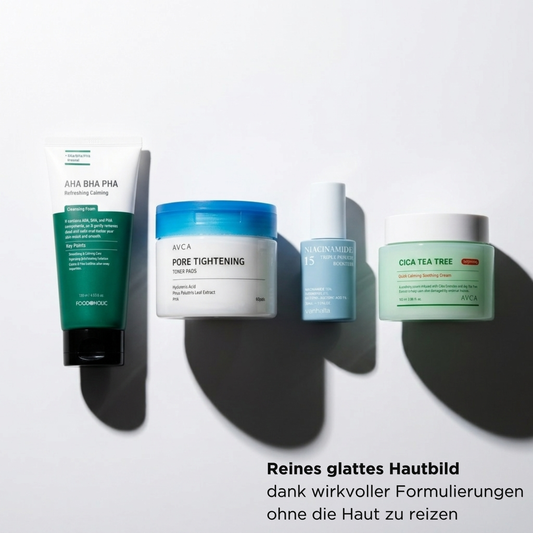
It was precisely these considerations that led to the creation of MISU Hydration & Skin Barrier. Instead of haphazardly combining individual products, this carefully curated 4-step set relies on a coordinated, barrier-friendly skincare routine specifically developed for dry and sensitive skin. The selection consistently follows the principles of Korean skincare: gentle, functional, and scientifically sound.
The set begins with a mild Foam Cleanser that thoroughly cleanses the skin without stripping lipids or irritating the skin barrier. This is followed by a Toner Spray with soothing active ingredients that provides moisture, reduces redness, and optimally prepares the skin for subsequent steps. A hydrating serum then supports the targeted rebuilding and stabilization of the skin barrier, while the final cream provides the skin with long-lasting moisture without over-caring or having an occlusive effect.
All four products are vegan, free from fragrances and colorants, and come from Korean brands that have dedicated their formulation philosophy specifically to strengthening the skin barrier and caring for sensitive skin. Together, they form a minimalist yet effective routine – ideal for anyone looking to calm, hydrate, and make their skin more resilient in the long term.

Don't underestimate your psyche: always allow yourself a conscious break from everyday life
A final note: Don't expect miracles overnight
Finally, it is important for me to emphasize that perioral dermatitis primarily needs two things: time and a balanced psyche. A damaged skin barrier does not repair itself overnight. Healing is a process that requires patience, mindfulness, and consistency. If you are in an acute stage, it is essential to seek medical advice. In this phase, the rule is: less is more. Avoid all skincare products and, only if the skin feels very tight, use a maximum of a light toner spray with suitable, soothing active ingredients.
Equally important in this time is to consistently avoid mechanical irritation. Peelings, cosmetic treatments, sauna visits, as well as wearing masks, scarves, or tight turtlenecks can further stress the skin and should be paused. Everyday habits also play a role: avoid touching your face constantly, and ensure thorough, regular cleansing and changing your towels to minimize inflammation-promoting bacteria.
My own healing took several months. However, the acute stage significantly subsided after about two to three weeks. Today, I still have dry and sensitive skin, but I have never experienced an acute flare-up again – even during very stressful periods of my life.
This showed me that perioral dermatitis is not just a matter of proper care, but above all of understanding your skin, your own body, and the time healing takes.